As elaborated by the Holy Quran….
Allah as the Sender of Rain:
The Quran consistently emphasizes that Allah is the one who sends down rain from the sky. This is mentioned in many verses, including:
These verses underscore the divine origin and the life-giving nature of rain.
Elaboration of the MMF’s Climate Change Awareness Project:
The Masajid & Madaris Foundation (MMF) has recognized the urgent need to address climate change, particularly given Pakistan’s vulnerability to its impacts. Their project strategically utilizes their existing infrastructure and influence within communities to disseminate information and promote action. The key elements of this initiative appear to be
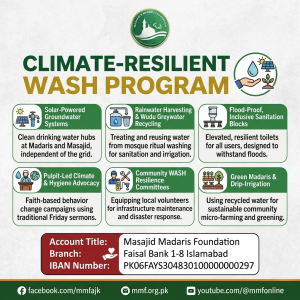
Pakistan stands at the frontlines of the global climate crisis, grappling with volatile weather patterns ranging from severe floods to prolonged droughts. Among the most critical sectors impacted by these environmental shifts is WASH (Water, Sanitation, and Hygiene). To address these issues sustainably, the Masajid & Madaris Foundation (MMF) has integrated faith-based leadership with modern climate adaptation through its Climate-Resilient WASH program.
By utilizing its vast network of mosques (Masajid) and religious schools (Madaris) across underserved and conflict-affected regions—such as Azad Kashmir and the Northern Areas—MMF transforms these trusted community spaces into structural and educational hubs for environmental resilience. MMF believes if these community hubs are sensitized and included in the CLIMATE CHANGE & ENVIRONMENTAL drives, much more results can be gained in the wide interest of the communities around.
Here is an analysis of the key, innovative projects that can be launched under this program area to drive lasting community-led climate adaptation.
Conventional water supply systems in remote parts of Pakistan often rely heavily on erratic electricity grids or diesel generators, which contribute to greenhouse gas emissions.
The Project: MMF can establish climate-smart, solar-powered deep groundwater boring installations attached to high-efficiency water filtration plants.
Implementation: Built right within or adjacent to Masjid compounds, these solar hubs ensure uninterrupted access to safe drinking water for both students and the surrounding populace. Solar energy guarantees operations continue even during climate-induced power grid failures (such as during heatwaves or floods), bypassing reliance on fossil fuels.
Water scarcity is an escalating threat in rural Pakistan, yet vast amounts of rainwater go uncollected, and significant volumes of water are discharged daily from ritual washing (ablution/Wudu).
The Project: Designing comprehensive rainwater collection systems and greywater recycling facilities inside multi-purpose Masajid and Madaris.
Implementation: Rainwater harvesting tanks can capture and store clean water from large mosque rooftops during the monsoon season. Simultaneously, wastewater from Wudu areas can be diverted through natural sand-and-gravel filtration systems. This recycled greywater can then be used safely for flushing sanitation facilities and irrigating community gardens or local eco-friendly agricultural initiatives, drastically reducing groundwater depletion.
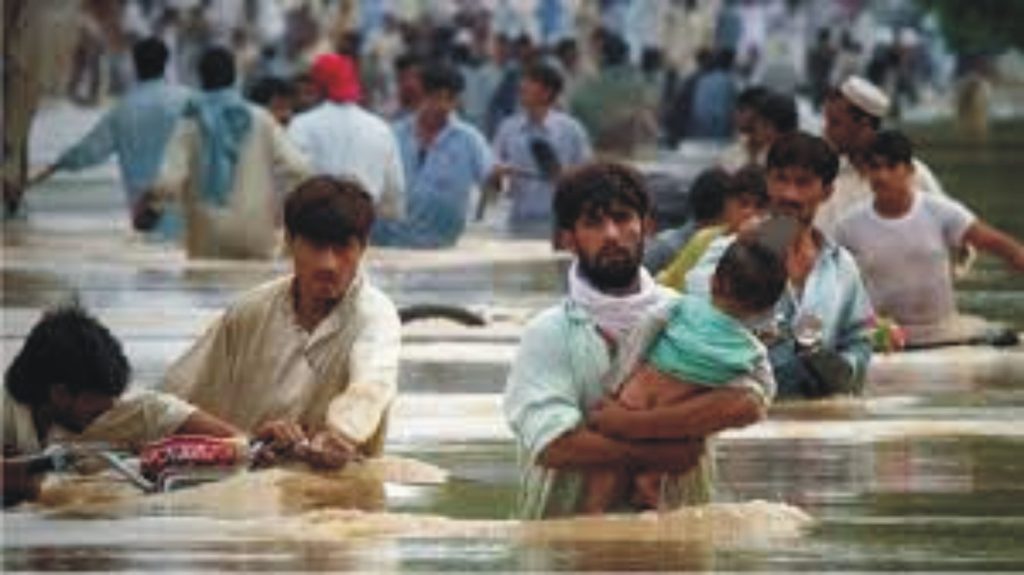
During extreme weather events like floods, conventional sanitation systems often overflow, contaminating local water bodies and causing widespread waterborne disease outbreaks.
The Project: Constructing elevated, disaster-resilient sanitation facilities at Madaris and community centers.
Implementation: These blocks would feature raised platforms, watertight septic tanks, and eco-sanitation designs to prevent waste leakage during floods. In alignment with MMF’s commitment to inclusivity, the projects would also include dedicated, secure sections for women, children, and people with disabilities, providing hygienic and safe spaces during emergencies.
Infrastructure alone cannot solve a climate crisis; behavioral adaptation is equally critical. MMF is uniquely positioned to bridge environmental science with Islamic stewardship (Khilafah).
The Project: A structured behavior-change communication campaign driven by religious leaders (Ulemas and Imams).
Implementation: Incorporating environmental preservation and hygiene themes into Friday sermons (Khutbahs) and daily madrassa curricula. By emphasizing Quranic verses that highlight water as a divine, life-giving resource (such as from Surah Al-Baqarah and Surah An-Nahl), Imams can advocate effectively for water conservation, proper handwashing, and the eradication of open defecation, neutralizing skepticism and inspiring grassroots civic action.
True climate resilience requires local maintenance and swift emergency mobilization.
The Project: Establishing “WASH Resilience Committees” stationed at functional community offices within the Masajid.
Implementation: MMF can train local youth and madrassa teachers in water-quality testing, minor infrastructure repair, and disaster preparedness. These committees act as localized first responders, equipped with water purification tablets and mobile filtration kits to safeguard public health immediately following a climate shock.
Climate-resilient WASH can be paired effectively with economic empowerment to build holistic community strength.
The Project: Utilizing treated WASH wastewater to support eco-friendly income generation.
Implementation: Madaris with available land can implement drip-irrigation systems fed by recycled wastewater to nurture kitchen gardens or small-scale tree nurseries. This not only tackles local deforestation and heat-island effects but also equips youth and Islamic educators with sustainable agricultural skills, providing food security and green income opportunities.